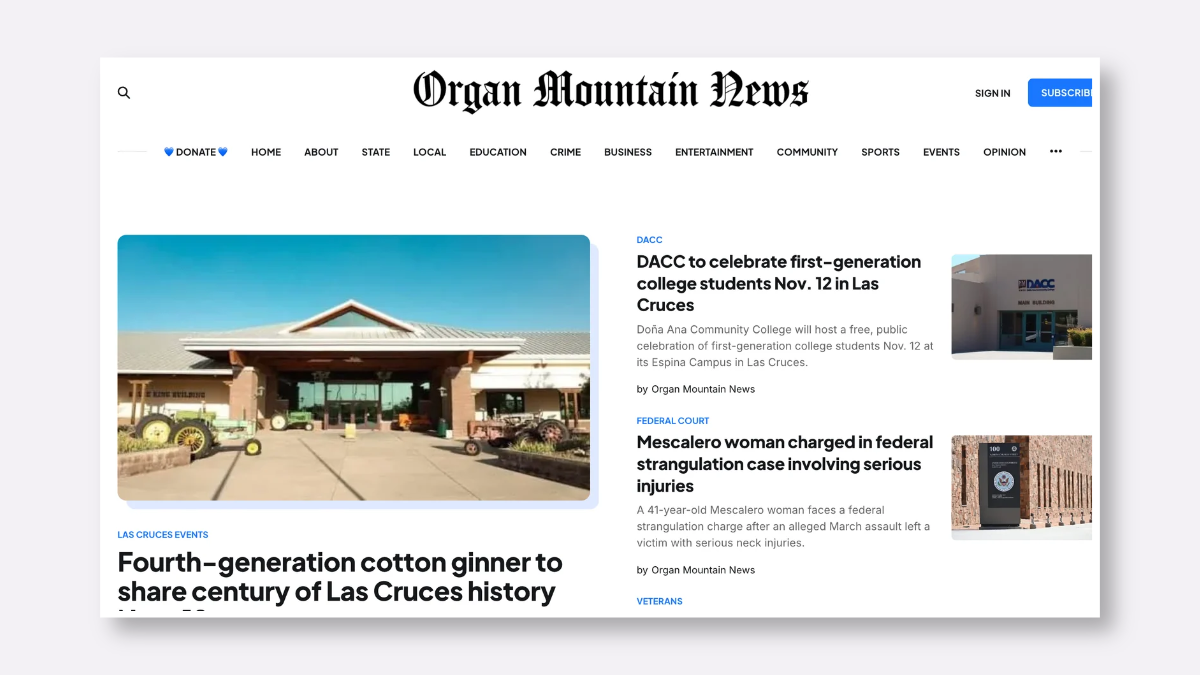
Damien Willis, founder and editor of Organ Mountain News (Las Cruces, N.M.), says at least 50 local news stories would not have been produced without SeeGov
Damien Willis runs Organ Mountain News by himself. Since he started using SeeGov in August 2026, he has published at least 50 original stories from public meetings his one-person newsroom otherwise couldn’t have covered, without adding a single staff member.
Challenge
School board, county and water district meetings run long, and Willis doesn’t have the hours to sit through them all. That meant missing discussions, policy decisions and emerging issues on public education, water, infrastructure and government spending that might otherwise have gone unreported.
What changed
The output tells the story:
- Eight stories in three days. Willis pulled them from meetings of the Gadsden Independent School District, the Doña Ana County Commission and a Las Cruces Public Schools Finance Subcommittee.
- Four stories from one meeting. An Aug. 12, 2026 Elephant Butte Irrigation District (EBID) meeting produced a 2027 water-supply warning, a push for $55 million in Rio Grande channel funding, risk assessments of all 27 EBID dams, and the rehabilitation of the Tortugas Site 1 dam.
Organ Mountain News reporting has also been referenced during public comment at both Doña Ana County Commission and Las Cruces City Council meetings.
The story behind the Tortugas Site 1 dam
A resident who lives near the dam contacted Willis after attending a public meeting. She was concerned that more people needed to understand the project’s potential consequences and substantial costs, and she specifically called for greater media attention so residents could become informed and contact their legislators.
Her outreach helped prompt Willis to examine EBID’s work more closely. Using SeeGov, he identified and reported on major issues discussed at district meetings, including the estimated $74 million dam rehabilitation project. The resident later expressed appreciation for Organ Mountain News’s willingness to investigate the issue and for the existence of an independent local newsroom.
“For me, that illustrates the value of this kind of reporting: Residents are asking for greater scrutiny of decisions that directly affect their communities, and SeeGov helps a one-person newsroom respond to those needs,” Willis said.
How it works
Willis starts with the SeeGov transcript and looks for moments worth pursuing. He cross-checks them against the agenda packet, then jumps to that point in the meeting video to verify a quote or hear the context. He estimates that saves him two to three hours per meeting, depending on the meeting’s length and the complexity of the issues.
In his words
“In the past three days alone, I’ve pulled eight original stories out of meetings I probably would not have had the time or bandwidth to sit through in full otherwise.”
“It has genuinely changed the economics of covering these meetings for a one-person newsroom.”
Beyond a single meeting
SeeGov now helps Organ Mountain News cover county and municipal governments, school districts, New Mexico State University and the Elephant Butte Irrigation District. Willis says the stories have exposed overlooked public spending, documented consequential government decisions and brought attention to issues affecting residents’ daily lives, from water security and infrastructure to education, housing and public accountability.
What began as a way to make meeting coverage more manageable has become an important part of the newsroom’s accountability-reporting infrastructure.
Next steps
Willis plans to use SeeGov to systematically monitor more public bodies across Doña Ana County and neighboring communities, especially school boards, municipal governments, and agencies responsible for water, infrastructure and public spending.
His goal is to move past finding the occasional story in a public meeting and build a consistent accountability-reporting practice that helps residents understand how government decisions affect their daily lives.
Advice for other small newsrooms
“If you’re running a small newsroom, especially a one-person operation like mine, SeeGov can be a game changer,” Willis said. “The biggest challenge isn’t a shortage of stories. It’s a shortage of hours.”
Important decisions get made at school board and city council meetings every week, he said, and no one person can attend or watch them all. SeeGov lets him quickly spot newsworthy discussions, review the supporting documents and watch the relevant part of the video. “I’m still doing the reporting, asking questions and verifying the facts — but I’m spending far less time searching for the story in the first place.”
His advice: “Don’t think of SeeGov as a shortcut to producing more content. Think of it as an opportunity to do more actual journalism — to hold more public bodies accountable, uncover stories your community needs to know and give residents a better understanding of the decisions being made on their behalf.”